
TECHNICAL BULLETIN: ACOUSTICS AND WOOD FLOORING: EVEN THE BEST-PERFORMING ACOUSTIC FLOOR CAN’T DO THE JOB ALONE.
What really makes the difference is the combination of the flooring, the subfloor, and the installation
Objective:
Understand how flooring, subflooring, installation methods, and building structure interact to influence acoustic performance, in order to better select a solution suited to the requirements of each project.
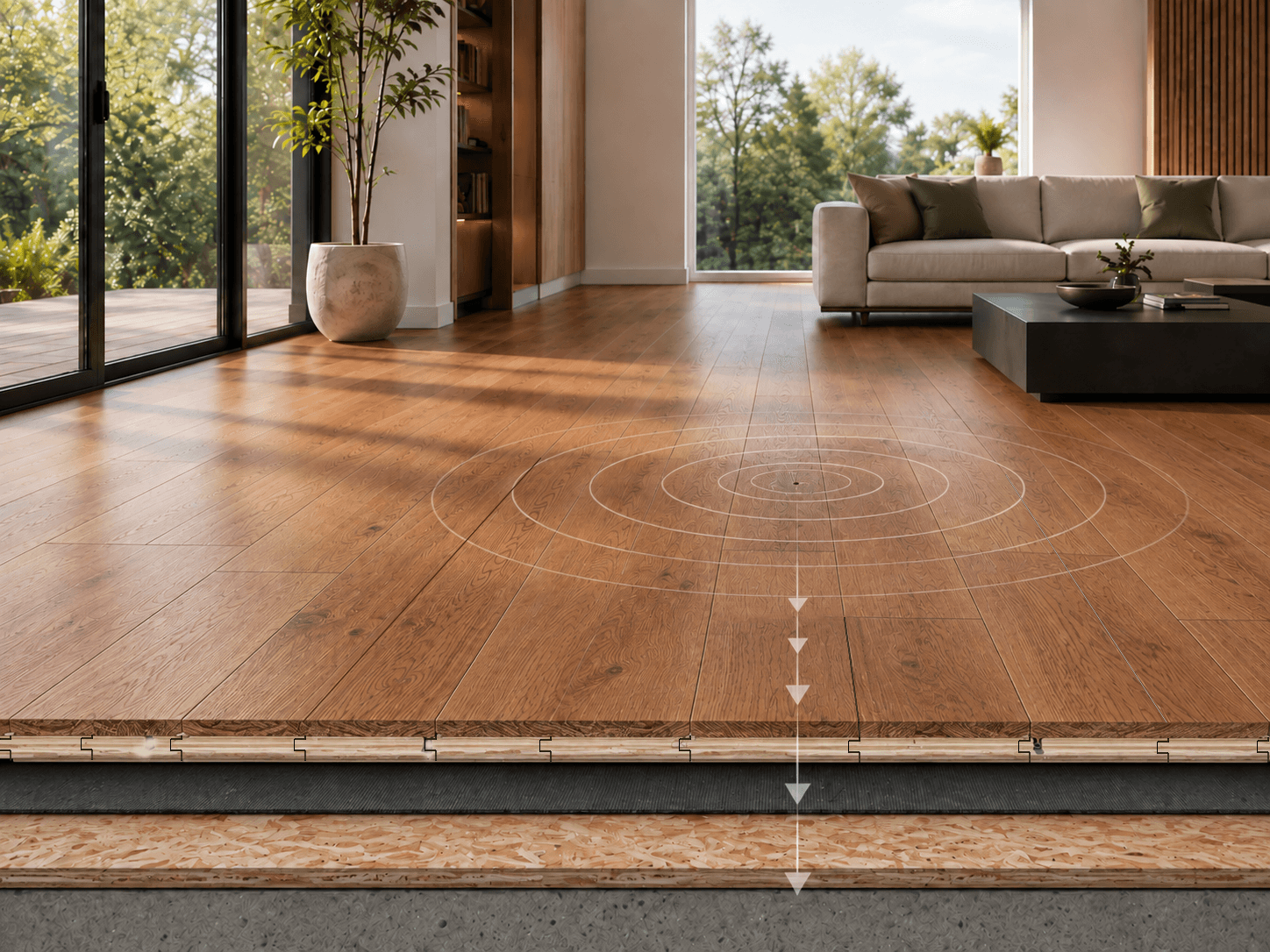
Silence Never Depends on a Single Product
When shopping for a hardwood floor, the first question is often a simple one:
“Which floor is the quietest?”
The answer, however, is far less simple.
Contrary to what one might think, the acoustic performance of a floor does not depend solely on the flooring product itself. Two identical floors can deliver completely different results depending on the subfloor, the installation method, and even the building structure.
In reality, good acoustic performance is always the result of a complete system in which every component plays a role.
Understanding how these elements interact not only helps create a more comfortable environment, but also makes it possible to choose the solution that is truly suited to the specific requirements of each project.
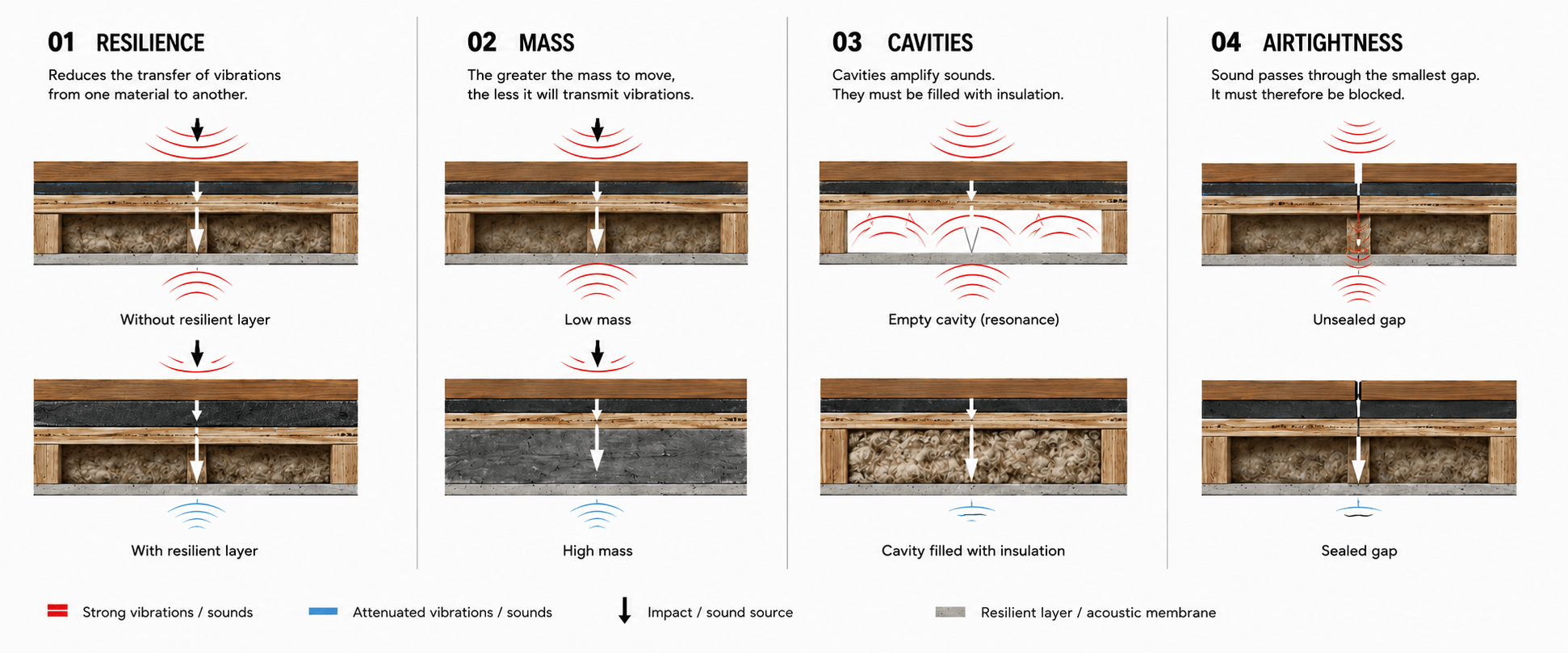
Acoustics can be broken down into four key principles that are closely interconnected; and ultimately inseparable.
- Resilience (The ability to reduce the transfer of vibrations from one material to another.)
- Mass (The greater the mass that must be moved, the less effectively it will transmit vibrations.)
- Cavities (Like a musical instrument, cavities tend to amplify sound. They should therefore be filled with insulating material to help reduce sound transmission.)
- Sealing (Sound consists of tiny vibrations travelling through the air around us. These vibrations can pass through even the smallest gaps, which is why those openings must be properly sealed.)
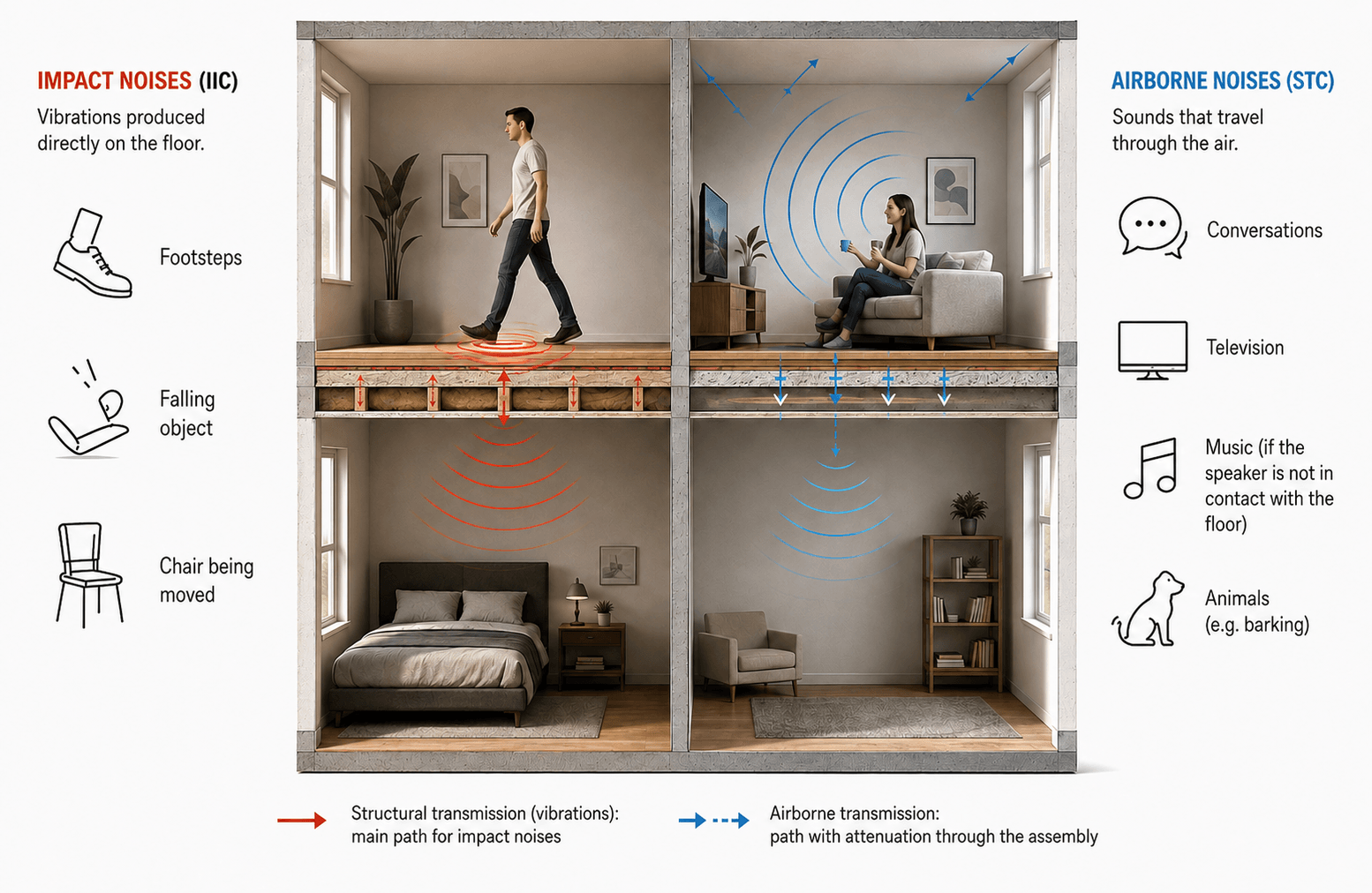
Understanding What We Hear (Two Ways Sound Travels)
When we think about acoustics, footsteps are often the first type of noise that comes to mind. However, many different types of sound travel through a building.
The most important are:
Impact Noise
(IIC, Impact Insulation Class)
These are vibrations and impacts generated directly on the floor.
For example:
- footsteps;
- a dropped object;
- a chair being moved.
These vibrations then travel through the flooring and the building structure.
Airborne Noise
(STC, Sound Transmission Class)
These are sounds that travel through the air.
For example:
- conversations;
- television;
- music (when speakers are not in direct contact with the floor);
- pets (e.g., barking).
Depending on the building’s design, these sounds can also be transmitted from one floor to another, or even from one room to another on the same floor.
An effective acoustic system must therefore help reduce both impact noise and airborne sound transmission.
First Factor: The Type of Flooring
Not all wood floors respond to vibrations in the same way. Their construction directly influences their ability to absorb or transmit sound.
In general, engineered flooring platforms provide better acoustic performance than solid hardwood floors thanks to their multilayer construction and variations in internal density, which help dissipate vibrations more effectively.
General Acoustic Performance
Preverco Flex Platform
↓
High-Performance Engineered Flooring
↓
Conventional Engineered Flooring
↓
Solid Hardwood Flooring
The Flex platform was designed to provide excellent dimensional stability, as well as superior acoustic performance when combined with an appropriate installation system.
However, even the best-performing floor cannot reach its full potential without the right subfloor.
Second Factor: The Subfloor (Membrane)
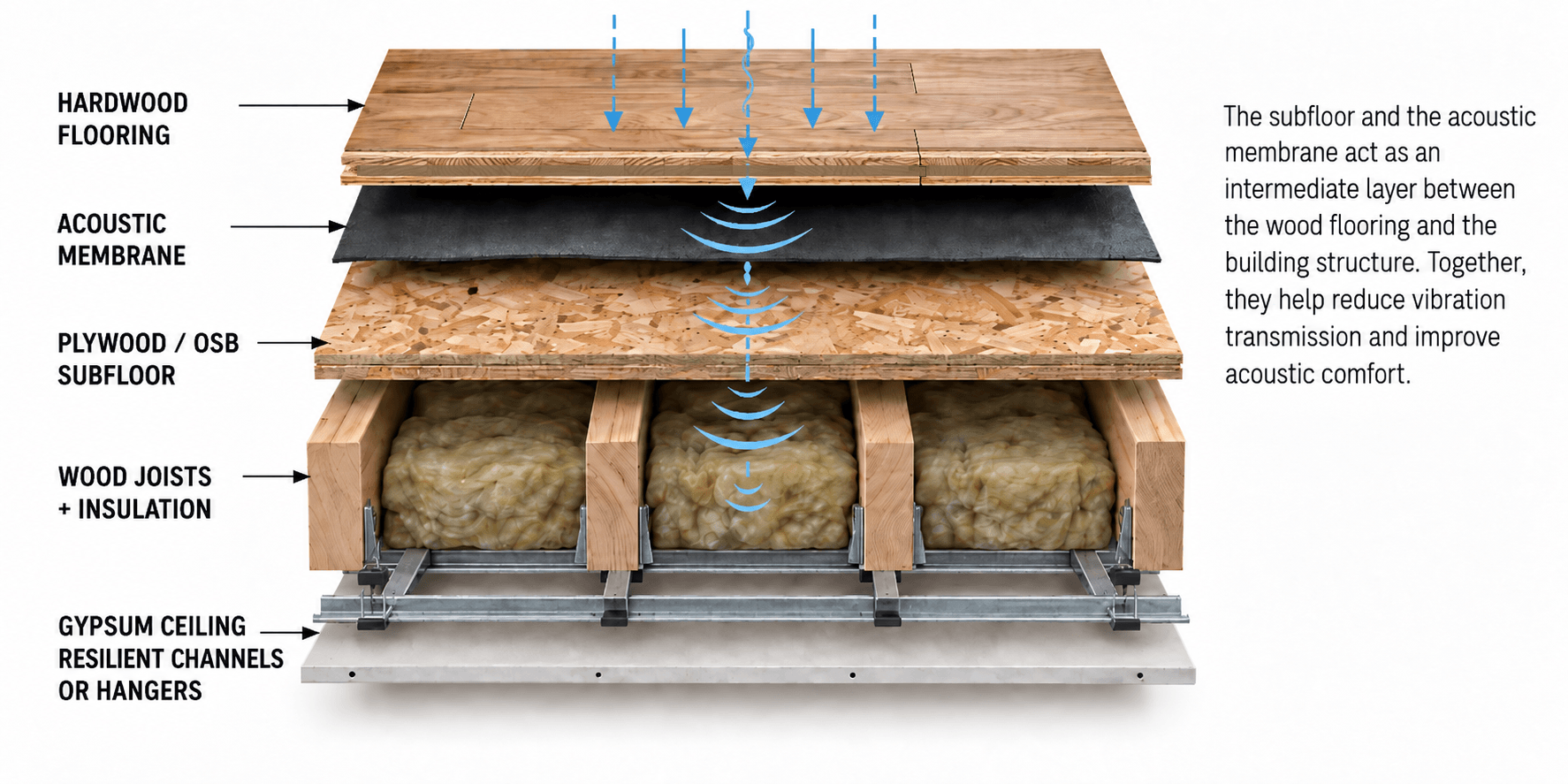
The subfloor acts as a true cushion between the building structure and the wood flooring.
Its role is often underestimated, even though it directly influences overall acoustic performance.
Depending on the type of membrane used, vibration transmission can be significantly reduced.
In general, acoustic subfloors can be grouped into several categories:
- high-performance acoustic membranes;
- specialized acoustic underlayments;
- multifunction membranes;
- standard underlayments (conventional, unprotected structure).
The choice of subfloor should always be based on the type of building, the installation method, and the desired acoustic performance.
Third Factor: The Installation Method
Even with the best materials, improper installation can significantly reduce acoustic performance.
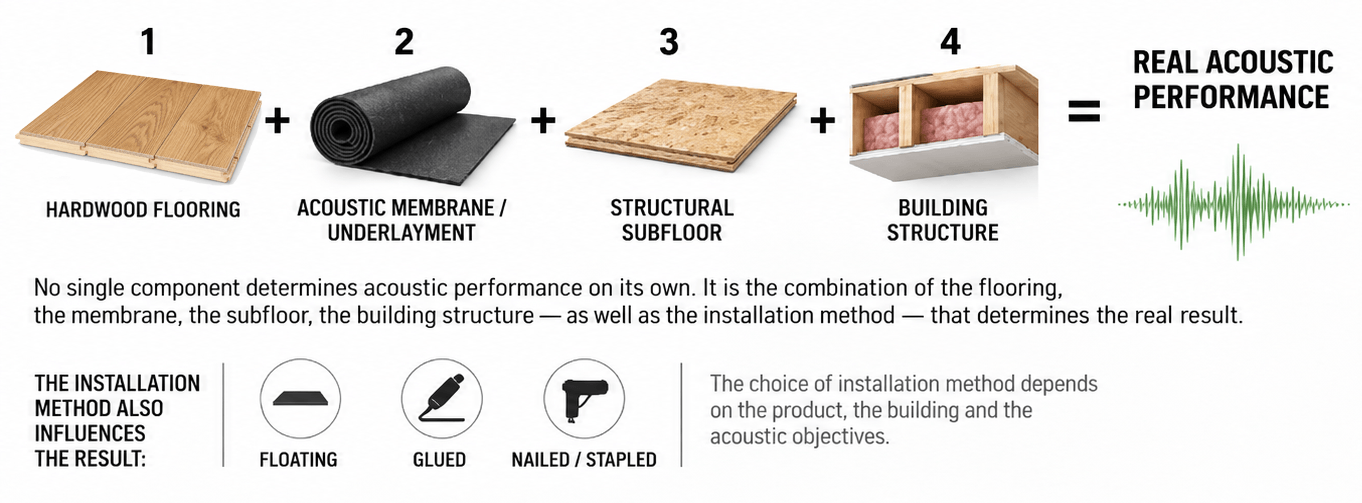
Depending on the project, three main installation methods are typically used:
- floating installation;
- glue-down installation;
- nail-down or staple-down installation over a substrate.
Each method offers its own advantages depending on the building structure, the type of flooring, and the desired performance.
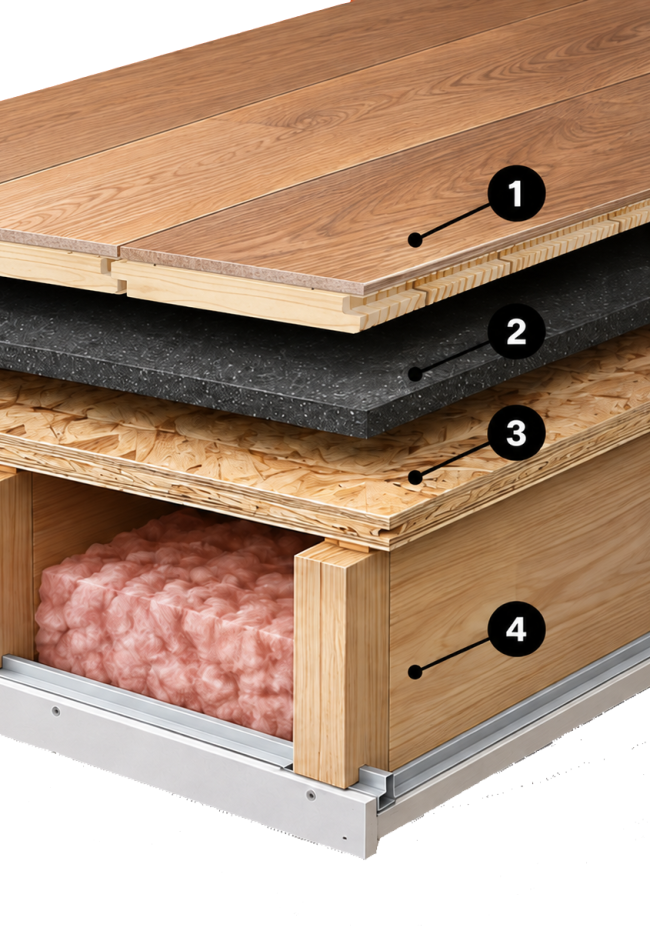
The Real Key: Combining the Components
We often try to identify the best flooring or the best membrane.
In reality, the best performance is always achieved when the entire system is optimized.
Flooring
+
Subfloor
+
Installation Method
+
Building Structure
=
Actual Overall Acoustic Performance
Conversely, an excellent subfloor can never fully compensate for flooring that is poorly suited to the application.
And even the best flooring will never reach its full potential if it is installed over an inadequate or poorly planned system.
Acoustic performance is, above all, a matter of balance.
Why Flex Stands Out Acoustically
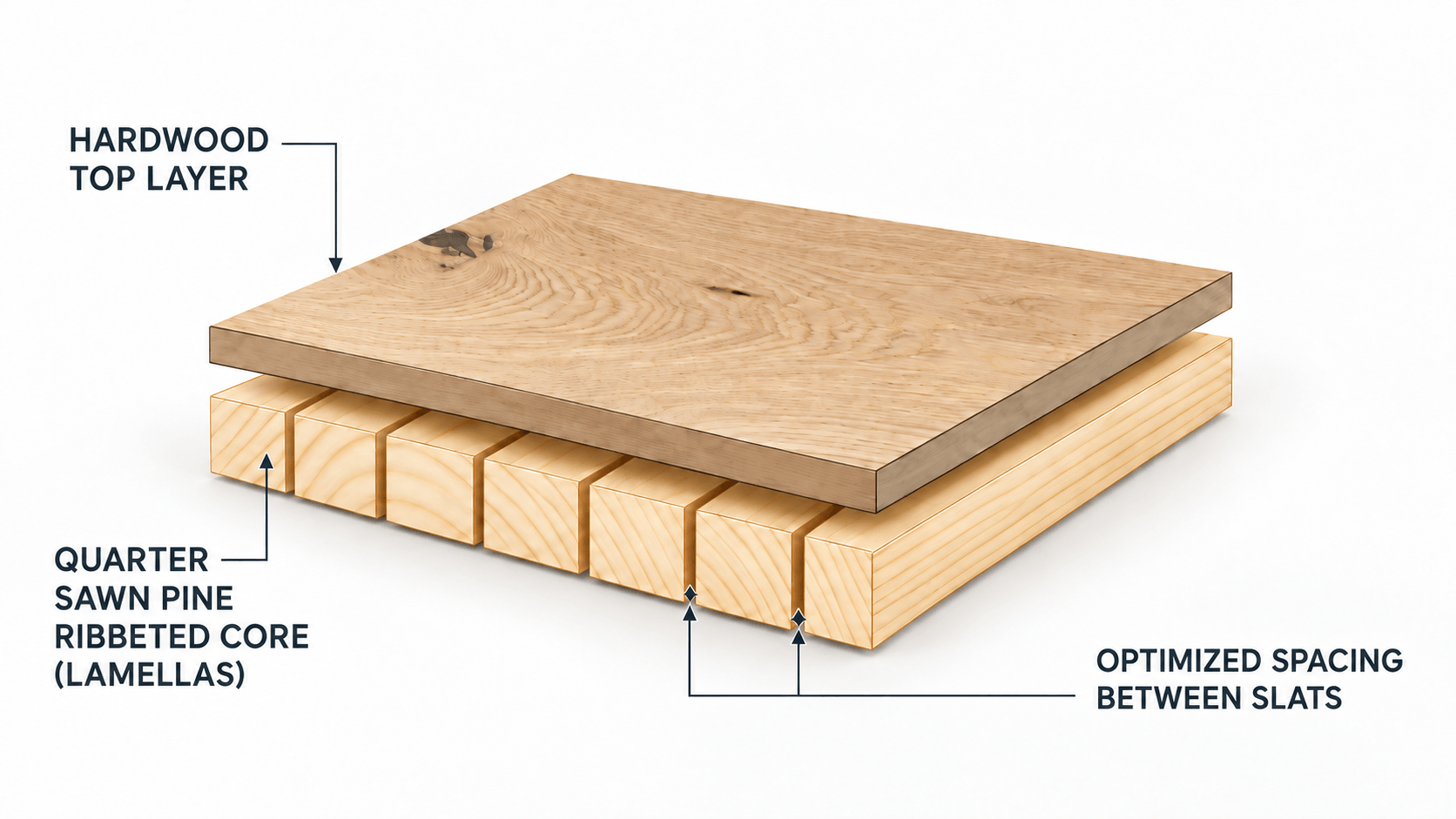
The design of the Flex platform substrate plays an important role in its acoustic performance. Unlike denser, more continuous engineered substrates, such as multilayer constructions made from Russian birch plywood, birch plywood, or certain cross-laminated bamboo structures, the Flex substrate is made of calibrated softwood slats separated by optimized spacing and oriented perpendicular to the hardwood top layer.
These spaces create small air chambers and, more importantly, discontinuities in the vibration transmission path. Acoustic energy therefore encounters more changes in materials, density, and contact points, helping to limit its vertical transmission through the plank.
The slight flexibility of this structure also allows the flooring to better conform to minor subfloor irregularities, reducing the formation of larger voids that could generate noise. Combined with an appropriate membrane and proper installation, this design helps explain why Flex achieved the best acoustic performance among the configurations tested.
Our Acoustic Testing
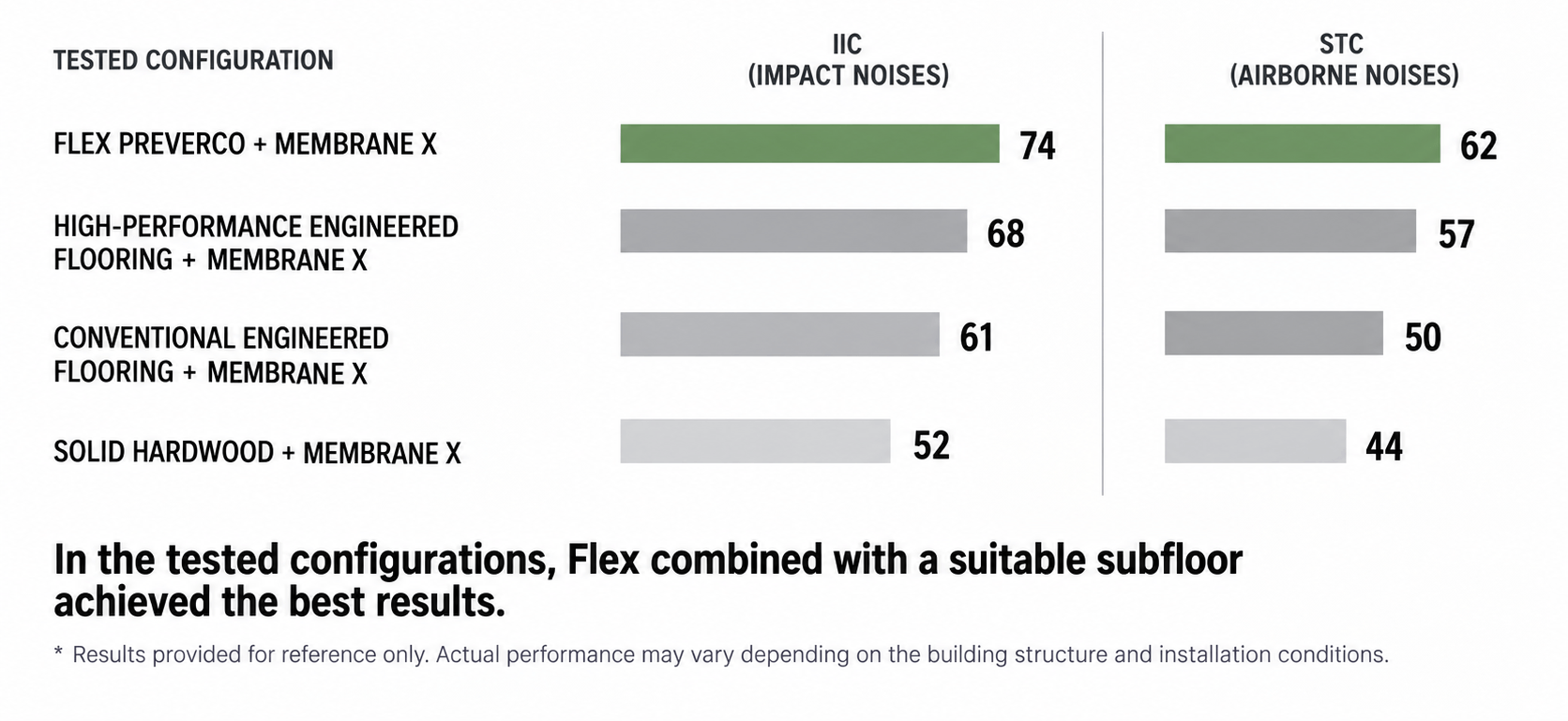
To objectively assess the performance of our various flooring platforms, several standardized laboratory tests were conducted.
The results clearly demonstrate that acoustic performance can vary significantly depending on the combination of components used.
Among the configurations tested, Preverco’s Flex platform, combined with an appropriate subfloor system, achieved the best results.
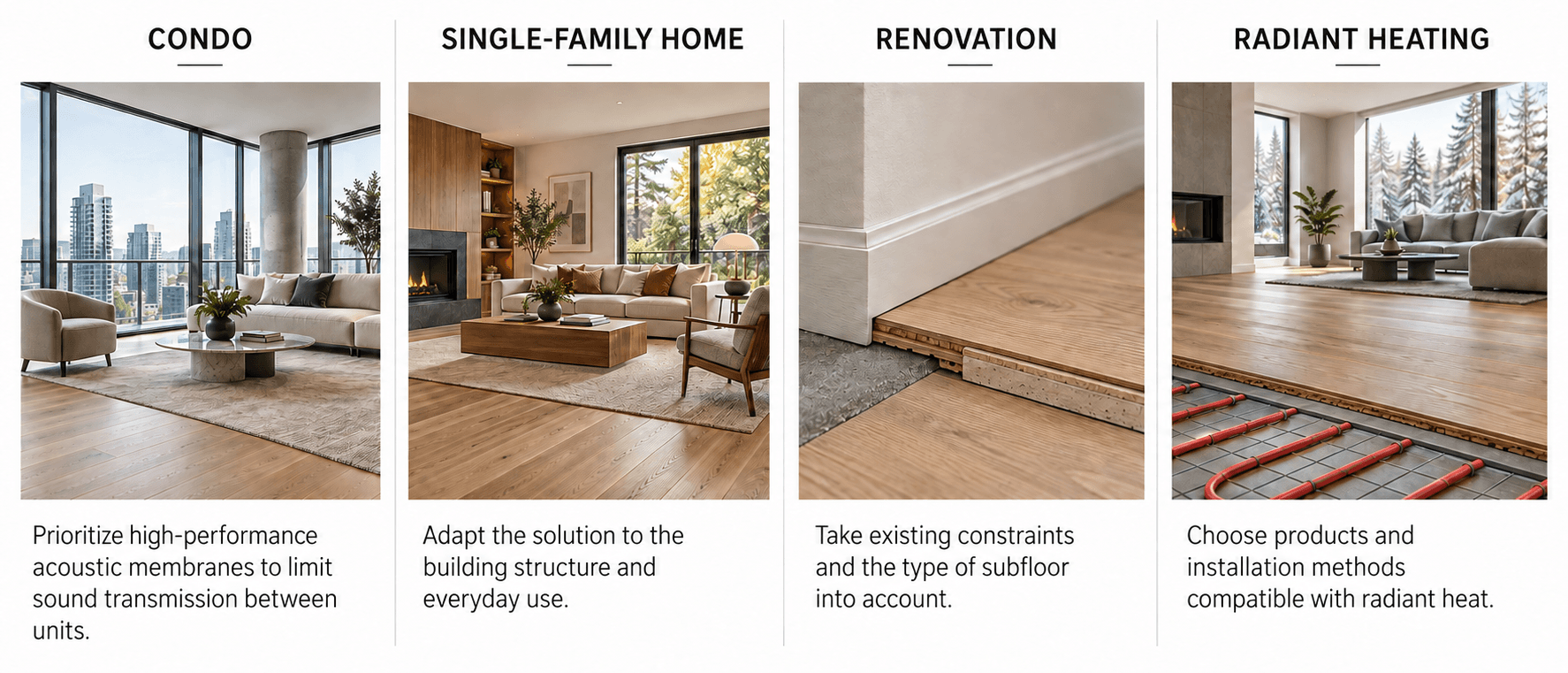
Choosing the Right Solution for Your Project
Every project has its own specific requirements.
Condo
Acoustic performance is often a priority in order to reduce sound transmission between units.
Single-Family Home
Everyday comfort and the reduction of footstep noise are generally the main objectives.
Renovation
The existing system, available floor height, and building conception and capacity of the structure all play an important role in selecting the appropriate flooring and subfloor system.
Radiant Floor Heating
Thermal and acoustic performance must be considered together in order to achieve a well-balanced system.
Did You Know?
Two installations using exactly the same flooring can deliver very different acoustic performance simply by changing the subfloor.
In other words, the sound level in a room is determined not only by the flooring itself, but by the entire system.

Myth or Reality?
“The thicker the floor, the quieter it is.”
False.
Thickness is only one of many factors that influence acoustic performance.
Floor construction, the subfloor, the installation method, and the building structure often play a much more significant role.

In Conclusion
There is no universal acoustic solution.
The best results are always achieved when the flooring, subflooring (membranes), the building structure itself, and the installation method are designed to work together as a complete system.
This performance also relies on four fundamental acoustic principles: resilience, mass, cavity treatment, and airtightness. Together, they help reduce the transmission of vibrations and sound through the various components of the building.
At Preverco, this comprehensive approach guides the development of each of our flooring platforms. Our testing demonstrates that a high-performance platform such as Flex, combined with an appropriate subfloor system and integrated into a properly designed assembly, can achieve a remarkable level of acoustic comfort.
Because when it comes to acoustics, silence never depends on a single product… but on all the choices made beneath your feet.